Fire extinguisher training at a glance
| Duration | 2–3 hours (theory + hands-on) |
| Prerequisites | None |
| Certification | Certificate of Completion, issued on the day |
| Recommended refresher | Annually, or whenever extinguisher types, layout or fire safety plan change |
| Group size | 5 to 50+ participants |
| Delivery | On-site (province-wide), augmented reality (FiAR), eLearning, virtual theory |
| Coverage | Every city and region in Ontario |
| Pricing | Group quote in CAD; volume rates for multi-site and multi-session bookings |
Is fire extinguisher training required in Ontario?
Yes, in practical terms — through two separate pieces of legislation that work together.
The Occupational Health and Safety Act. Section 25(2)(a) requires employers to provide workers with information, instruction and supervision to protect their health and safety. Where your emergency procedures expect a worker to pick up an extinguisher, that instruction has to exist and you have to be able to show it. In industrial establishments, R.R.O. 1990, Reg. 851 (ss. 120–123) carries fire extinguisher and exit-access requirements directly into the workplace.
The Ontario Fire Code (O. Reg. 213/07). Division B, Section 6.2 governs portable extinguishers — where they are installed, how they are signed, and how they are maintained. Article 6.2.7.2 requires monthly inspection, and 6.2.7.1 requires maintenance and testing in conformance with NFPA 10. Section 2.8 covers fire safety plans, including the requirement for supervisory staff to be trained in the procedures set out in that plan.
The Code makes the building owner responsible, and defines “owner” broadly — it can capture property managers, long-term lessees and tenant organisations at the same time. If you are unsure whether the obligation sits with you or your landlord, assume it is shared until your lease says otherwise.
What this means for a typical Ontario employer
- Extinguishers are installed, visible, unobstructed and signed
- They are inspected monthly by your own staff and serviced annually by a qualified technician
- Your fire safety plan names who does what in an emergency
- The people named in that plan have been trained — and you have the records to prove it
Most Ontario workplaces get the first three right and fail on the fourth. Training records are what a fire prevention officer asks for after an incident, and what your insurer asks for during a claim.
What the training covers
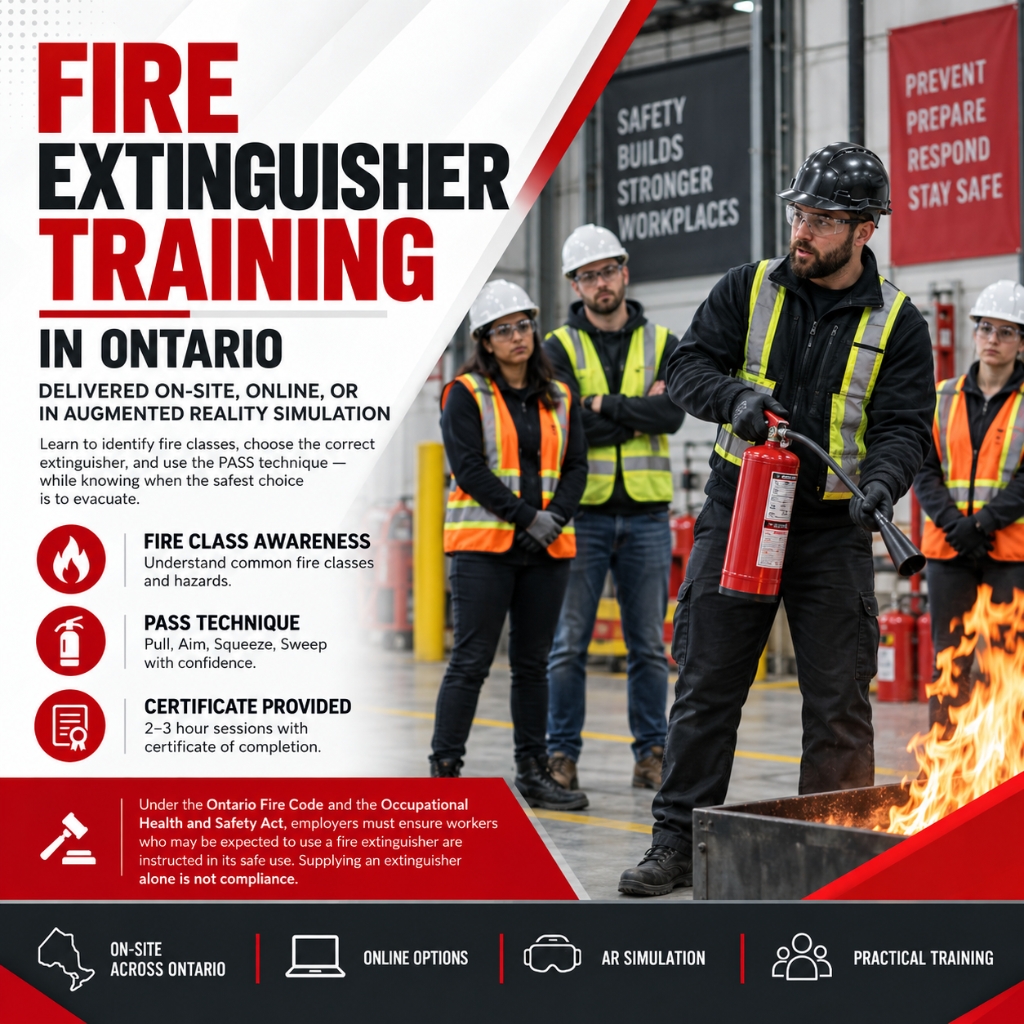
Every session is built around the fire your team is actually likely to face — a fryer in a commercial kitchen, an electrical panel in a plant, a battery charging station in a warehouse.
- Fire science and the fire triangle — fuel, oxygen and heat, and why removing one element ends the fire
- Fire classifications — Class A, B, C, D and K fires and the extinguishing agent each one requires
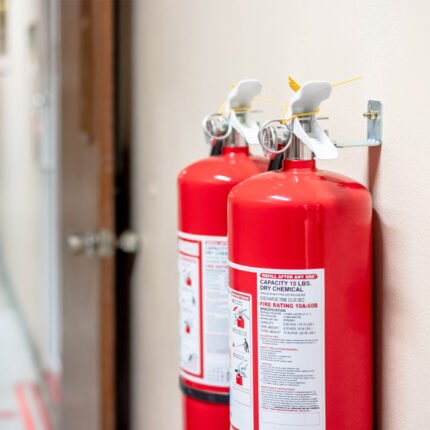
- Extinguisher identification — ABC dry chemical, CO₂, water, wet chemical and Class D units, and how to read the rating label
- Inspection and readiness — pressure gauges, pin and seal, obstruction and signage checks, and how to complete a monthly inspection that satisfies the Fire Code
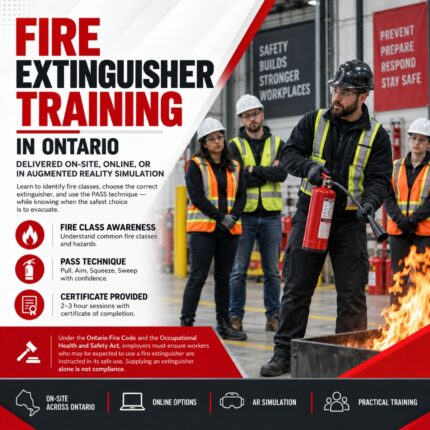
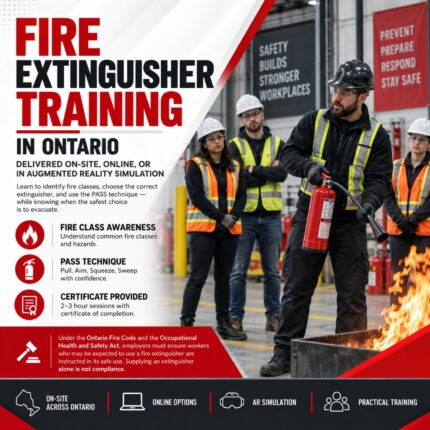
- The PASS technique, hands-on — Pull, Aim, Squeeze, Sweep, practised until it is automatic
- When not to fight a fire — size, smoke conditions, exit position, and the discipline to leave
- Emergency procedures — sounding the alarm, evacuation routes, assembly points, assisting occupants who need help to evacuate, and what to do if a person’s clothing ignites
- Fire prevention in your space — housekeeping, hot work, flammable storage and ignition source control
Completion requirements: attend and participate in the full session, demonstrate correct extinguisher use with the PASS technique, and complete all practical exercises. Each participant receives a Fire Safety Guidelines pamphlet and a certificate of completion.
Four ways to run the training
1. On-site at your workplace — most requested
Our instructors bring the extinguishers, simulation equipment and demo gear to you. Your floor becomes the classroom, which means the hazards discussed are the ones your team walks past every shift. Available in every Ontario city and region.
2. Augmented reality — FiAR
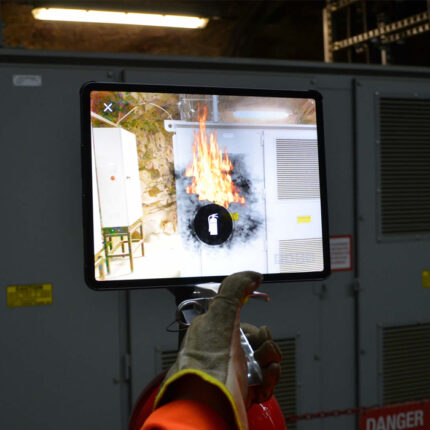
FiAR simulates realistic fire scenarios through augmented reality instead of live flames. Participants select an extinguisher, approach, and apply the PASS technique against a simulated fire that responds to what they do — with instant feedback on their technique.
It solves the problem that keeps most offices, schools, hospitals and condo corporations from running hands-on training at all: no live burn, no discharge residue, no outdoor space required, no fire watch. It runs indoors, in a boardroom, in winter.
3. eLearning — self-paced
A fully online fire safety course for individual learners, remote teams and new-hire onboarding. Available 24/7, certificate issued on completion. Best used as the theory layer ahead of a hands-on session, or where a worker’s role will never place them in front of an extinguisher.
4. Virtual theory, blended with on-site practical
Live instructor-led theory delivered online to distributed teams, followed by a short on-site practical day at each location. This is the most efficient format for Ontario employers running multiple sites — one theory session covers everyone, and the practical component travels.
Fire extinguisher training across Ontario
We deliver on-site anywhere in the province. F.A.S.T. Rescue maintains training locations in Toronto, Mississauga, Etobicoke, Newmarket and Hamilton, with instructors travelling from these bases across the GTA, Golden Horseshoe, Southwestern and Eastern Ontario. Northern Ontario sessions are available by request.
| Ajax | Kingston | Ottawa |
| Barrie | Kitchener | Pickering |
| Brampton | London | Richmond Hill |
| Brantford | Markham | Scarborough |
| Burlington | Milton | St. Catharines |
| Caledon | Mississauga | Toronto |
| Cambridge | Newmarket | Vaughan |
| Etobicoke | North York | Waterloo |
| Guelph | Oakville | Whitby |
| Hamilton | Oshawa | Windsor |
Don’t see your city? We travel province-wide, including to sites with no nearby training centre. Email info@fast-rescue.com with your location and headcount.
Who needs fire extinguisher training
Anyone named in your fire safety plan, plus anyone whose work introduces an ignition source.
| Sector | Why it applies |
| Manufacturing & industrial | Hot work, combustible dust, flammable liquid storage |
| Warehousing & logistics | Lithium battery charging, packaging materials, racking fire loads |
| Construction | Temporary heat, cutting and welding, no fixed suppression |
| Healthcare & long-term care | Oxygen-enriched environments, occupants who cannot self-evacuate |
| Restaurants & food service | Class K grease fires, hood suppression systems |
| Offices & property management | Fire safety plan supervisory staff, floor wardens |
| Retail & grocery | High occupant load, public present |
| Schools & childcare | Occupants requiring assisted evacuation |
| Hotels & hospitality | Overnight occupancy, guests unfamiliar with exits |
| Municipal & institutional | Fire Code compliance across multiple buildings |
Why Ontario employers choose F.A.S.T. Rescue
Canadian, veteran-owned and operating since 1998. We are an authorized Canadian Red Cross provider, approved by WSIB, the MLITSD and provincial WCBs, and a Health Canada MDEL holder. Organisations including Mattamy Homes, Meta, Cargill, Smurfit Westrock, Maple Leaf Consumer Foods and Trent University train with us.
Instructors come from occupational health and safety, fire prevention and emergency response, and industrial operations — not from a script. They have stood in plants and on sites like yours.
The part no competitor matches: we supply the equipment as well as the training. Through First Aid Supply Stores we stock extinguishers, fire blankets, signage, evacuation chairs and emergency equipment. One supplier can bring your extinguishers up to Fire Code standard and train the people who will use them, on the same purchase order. Training providers can’t do that. Equipment vendors can’t train.
Booking and pricing
- Groups of 5 to 50+
- Volume pricing across multiple locations or sessions
- Evenings and weekends available on request
- Pricing quoted in CAD, per group
📧 info@fast-rescue.com — include your city, headcount, preferred format and target dates, and we’ll confirm availability.
Frequently asked questions
Is fire extinguisher training mandatory in Ontario?
Where your emergency procedures or fire safety plan expect a worker to use an extinguisher, yes. OHSA s. 25(2)(a) obliges employers to provide instruction, and Section 2.8 of the Ontario Fire Code requires supervisory staff to be trained in fire safety plan procedures. Providing an extinguisher without instruction does not meet either obligation.
How often should fire extinguisher training be repeated?
Annually is the accepted practice in Ontario workplaces. Retrain sooner if your extinguisher types change, you move or reconfigure your space, your fire safety plan is revised, or a drill shows staff hesitating.
How long is the course?
Two to three hours, covering theory and hands-on practice. Blended delivery can shorten the on-site portion where theory is completed online first.
Do participants discharge a real extinguisher?
In on-site sessions, yes — participants practise with training extinguishers under instructor supervision. If live discharge isn’t practical in your building, the FiAR augmented reality option delivers the same hands-on repetitions without flame or residue.
Does the certificate expire?
The Certificate of Completion does not carry a hard legislated expiry in Ontario, but annual refresher training is the standard employers are held to. Most insurers and auditors expect records no older than twelve months.
What extinguisher types does the training cover?
Class A for ordinary combustibles, Class B for flammable liquids, Class C for energised electrical equipment, Class D for combustible metals, Class K for cooking oils, and multipurpose ABC units. We train on the types installed in your building.
Can you train at multiple Ontario sites?
Yes. Multi-site programmes are common — a single virtual theory session for all locations, followed by scheduled on-site practicals at each. Volume pricing applies.
Can you also supply our fire extinguishers?
Yes. Extinguishers, fire blankets, signage, evacuation chairs and emergency equipment are available through First Aid Supply Stores, our equipment division. Email info@fast-rescue.com and we’ll quote equipment and training together.
📧 Book fire extinguisher training for your Ontario team: info@fast-rescue.com
































Reviews
There are no reviews yet.