🚨
WSIB Update
Ontario’s new First Aid Program took effect June 22, 2026.
Learn more →




First Aid Training for Construction Companies in Ontario and Alberta: What Requirements Apply?

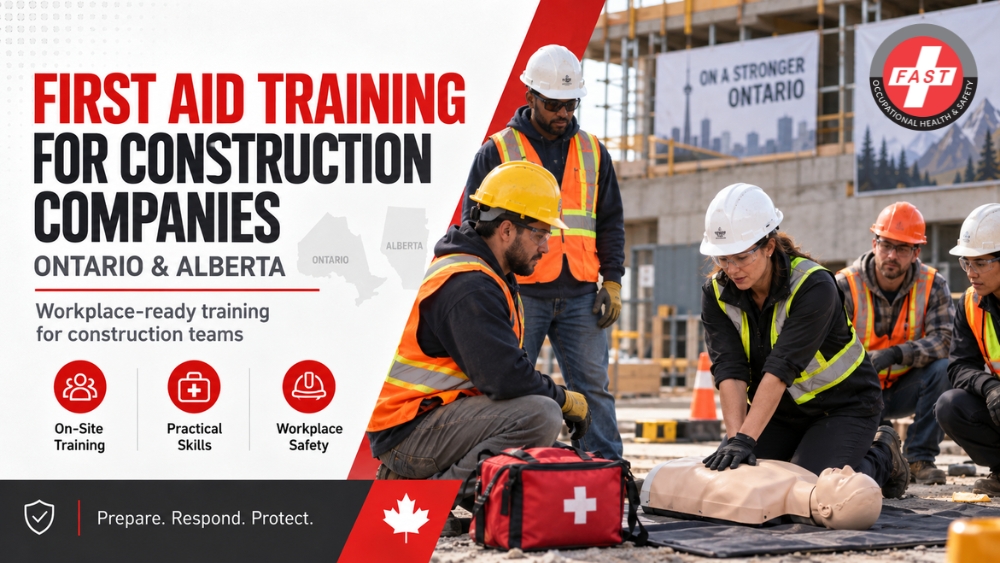
Construction sites can change quickly, and emergency response needs to keep up. Falls from height, struck-by incidents, electrical contact, trench collapses, and heavy equipment accidents can escalate within minutes. Having trained first aiders and the right equipment available before emergency services arrive is a practical safety control — and, in Ontario and Alberta, a regulated part of construction site planning.
Both Ontario and Alberta impose specific first aid requirements on construction companies — requirements that go beyond what applies to lower-risk workplaces. Ontario construction sites are governed by two separate regulations: Regulation 1101, which sets baseline first aid standards for all Ontario workplaces, and Regulation 213/91, which adds construction-specific obligations including mandatory AEDs on qualifying projects. Alberta construction sites fall under Part 11 of the OHS Code, where construction is classified as high hazard — triggering the most demanding tier of first aider and kit requirements in the province.
This guide covers the Ontario and Alberta requirements discussed below, what changed in 2026, and how construction companies can maintain first aid coverage as site conditions change by the week.
Quick answer: In Ontario, construction employers need to plan around Regulation 1101 first aid requirements and, on qualifying projects, the Regulation 213/91 AED rule. In Alberta, construction first aid requirements are based on hazard level, worker count, and distance from a health care facility under Part 11 of the OHS Code. In both provinces, the right course, number of first aiders, and kit setup depend on who is on site, when they are working, and how quickly first aid can reach them.
Why Construction Sites Require Strong First Aid Planning
Before getting into the regulations, it is worth understanding the specific emergency scenarios construction first aid training must address. These are not the slip-and-fall or soft-tissue injuries that dominate most office-based incident reports. Construction emergencies can be severe, fast-moving, and involve more than one worker.
The most common life-threatening incidents on construction sites include:
- Falls from height are a leading cause of serious and fatal injuries on construction projects. Falls from scaffolding, ladders, roofs, and open-floor edges can cause head and spinal injuries, fractures, and internal bleeding that require immediate stabilization and bleeding control.
- Struck-by incidents — falling tools, swinging loads, reversing vehicles, and collapsing formwork. Blunt trauma with high-energy transfer requiring rapid assessment and hemorrhage control
- Caught-in or caught-between incidents — machinery entrapment, trench and excavation collapses, and crushing injuries between equipment and fixed structures
- Electrical contact — from overhead lines, underground utilities, and temporary site power. May cause cardiac arrest requiring immediate CPR and AED deployment
- Heat emergencies — heat exhaustion and heat stroke on outdoor summer sites, particularly during concrete pours and roofing work
- Cold exposure — hypothermia and frostbite on winter construction sites in Ontario and Alberta
- Chemical exposure — from solvents, adhesives, concrete admixtures, and coatings
- Multiple simultaneous casualties — large-scale incidents such as scaffold collapses or structural failures may injure several workers at once
These risks are exactly why construction-specific first aid regulations exist in both Ontario and Alberta — and why minimum requirements may not fully reflect the practical conditions on site.
Ontario Requirements: Two Regulations Construction Companies Need to Consider
Ontario construction sites need to consider both Regulation 1101 and Regulation 213/91. Regulation 1101 sets workplace first aid requirements such as trained first aiders, first aid boxes, records, and inspections. Regulation 213/91 adds construction-project duties, including the AED requirement that applies to qualifying projects as of January 1, 2026.
Regulation 1101 — The Foundation: Training, Kits, and Documentation
Ontario Regulation 1101 under the Workplace Safety and Insurance Act (WSIA) applies to Ontario workplaces covered by the WSIA framework, including construction sites. It sets the baseline requirements for:
- At least one trained first aider on every shift while workers are present
- First aid kits stocked to prescribed levels based on the number of workers on site
- WSIB Form 82 (“In Case of Injury at Work”) posted in a visible location
- A written record of every first aid treatment provided on site
- Quarterly kit inspections with dated, signed records kept on file
For construction sites, Regulation 1101 includes specific provisions under sections 12 to 14 for transportation, construction, farm, and bush sites. These provisions set out how first aid boxes and stations are to be provided in those settings, so construction employers should confirm the applicable section before relying on a general office-style first aid setup.
Which First Aid Course Does Your Ontario Construction Site Need?
The required certification level is based on the maximum number of workers present on any single shift:
| Workers on Site Per Shift | Required Certification | Updated Name (2026) | Duration |
| 1–5 workers | Emergency First Aid + CPR | Basic First Aid | ~7 hours (1 day) |
| 6+ workers | Standard First Aid + CPR | Intermediate First Aid | ~13 hours (2 days) |
Most active construction sites — even small residential projects with a handful of trades working simultaneously — exceed five workers per shift. Intermediate First Aid is the practical standard for the vast majority of Ontario construction sites.
These course names updated on June 22, 2026 under the WSIB’s updated First Aid Program aligned with the CSA Z1210:24 national standard. Compliance thresholds did not change. All training must be delivered by a WSIB-approved provider.
For a full breakdown of which course applies to your specific workplace, see our guide: which first aid course does your Ontario workplace need?
The 120-Second Rule on a Construction Site
WSIB guidance expects first aid to be easy to access for prompt treatment. In practice, Ontario employers often use the 120-second access expectation as a planning benchmark for trained first aider coverage, especially on larger or multi-level construction sites.
A trained first aider on the third floor of a wood-frame residential build cannot realistically reach a worker injured in the basement or at a perimeter trench within 120 seconds. Practical compliance on construction sites typically means:
- At least one trained first aider per active floor or work level
- Coverage in physically separate zones — foundation work, structural, finishing trades
- Designated first aid coverage during critical operations where injury risk is highest
If a Ministry of Labour, Immigration, Training and Skills Development inspector determines that your first aid coverage is not readily accessible for the workers and layout of the project, certificates on file may not be enough to show that the site is meeting its first aid obligations.
First Aid Kits on Ontario Construction Sites
Construction site kits under Regulation 1101 must be stocked appropriately for the number of workers and must be accessible across the site — not just in the site trailer. Key requirements include:
- Kits inspected at least quarterly, with inspection records on file
- Depleted or expired items replaced immediately
- Kits protected from weather, dust, and contamination typical of construction environments
- Every kit includes a current approved first aid manual
On larger sites, multiple first aid stations or kits may be needed to keep first aid readily accessible for prompt treatment across active work areas. A site office kit alone is often not enough for a multi-level, multi-zone, or spread-out project.
Ontario Regulation 213/91 — Construction-Specific Rules
Ontario Regulation 213/91 (Construction Projects) is a separate regulation that applies only to construction sites and adds requirements above and beyond Regulation 1101. This regulation is sometimes missed during first aid compliance reviews.
In addition to everything required under Regulation 1101, Regulation 213/91 includes construction-specific obligations related to first aid provisions, site conditions, and as of January 2026, mandatory AEDs on qualifying projects.
AED Requirements for Qualifying Ontario Construction Projects
Under section 27.1 of Regulation 213/91, as added by O. Reg. 157/25, constructors must ensure an Automated External Defibrillator (AED) is installed and maintained at a project where 20 or more workers are regularly employed, unless the work at the project is expected to last less than three months.
- Twenty or more workers are regularly employed at the project
- The work at the project is expected to last three months or more
If your project meets both thresholds, AED compliance is required for qualifying projects.
The AED must:
- Be licensed as a Health Canada medical device
- Be accompanied by required accessories: one CPR mask, one pair of scissors, two pairs of disposable medical-grade gloves, one disposable razor, one garbage bag, and four absorbent towels
- Be protected from dust, moisture, and substances present on site that could damage it
- Be maintained and tested according to the manufacturer’s instructions, inspected quarterly by a competent worker, and supported by inspection records kept with the AED
- Be readily accessible at all times while work is in progress
A worker trained in CPR and AED operation must be present at all times while work is in progress on projects where section 27.1 applies.
This is a significant new obligation for Ontario general contractors and constructors. If your site meets the AED threshold and does not have a Health Canada-licensed AED installed and maintained on site, it may be out of compliance with Regulation 213/91.
Our CPR and AED training can help designated workers build the skills needed to respond with an AED on qualifying Ontario construction projects. Confirm the exact training expectations that apply to your project and role before booking.
WSIB AED Reimbursement: Up to $2,500 Per Project
To support compliance with the new AED requirement, the WSIB is offering reimbursement of up to $2,500 for the initial purchase cost of one AED per qualifying construction project.
Key details:
- One AED reimbursed per project
- Maximum reimbursement: $2,500
- Supporting documents required: receipts and Notice of Project
- Application deadline: July 31, 2027
- Reimbursement does not cover training, ongoing maintenance, or replacement
Apply through the WSIB reimbursement program (Regulation 360/25: Reimbursement For Defibrillators). Construction companies may be able to recover part of the AED purchase cost if they apply before the deadline.
The 2026 WSIB First Aid Program Update — What Changed for Ontario Contractors
On June 22, 2026, the WSIB launched its updated First Aid Program aligned with the CSA Z1210:24 standard. For Ontario construction companies, the key changes are:
- Emergency First Aid is now called Basic First Aid
- Standard First Aid is now called Intermediate First Aid
- Training completed on or after June 22, 2026 should be delivered by a provider approved under the updated WSIB First Aid Program
- Existing certificates issued before June 22, 2026 remain valid until expiry — no early renewal required
- Regulation 1101 itself was not changed — all headcount thresholds and compliance standards remain the same
Alberta Requirements: High Hazard, Dynamic Sites, Prime Contractor Accountability
Alberta construction companies face a more complex first aid compliance framework than most other industries in the province. Construction is classified as high hazard under Schedule 2 of the Alberta OHS Code — the category with the most demanding first aider, certification, and kit requirements.
Construction Is High Hazard Under the Alberta OHS Code
The Alberta OHS Code uses Schedule 2 to classify work by hazard level. Construction, demolition, excavation, and similar work are treated as high-hazard categories for first aid planning, so the office trailer does not lower the classification when the worksite is operating as a construction project.
This matters because high-hazard classification triggers the most stringent tier of requirements for first aider count, certification level, kit type, and distance-based adjustments.
The Three-Variable Formula: Hazard Level + Worker Count + Site Distance
Unlike Ontario, Alberta uses a three-variable formula to determine your exact requirements:
- Hazard level — Construction = High Hazard
- Workers per shift — the maximum number of workers on site at any one time
- Worksite distance from a health care facility — classified as close, distant, or isolated under Schedule 2 based on travel time and communication conditions
Getting any one of these three variables wrong can lead to the wrong first aid plan. A construction site that appears covered based on headcount alone may still need a higher level of first aiders, equipment, or transport planning if the distance to the nearest health care facility has been underestimated — particularly when winter road conditions, rural routes, and emergency response delays affect realistic travel time.
How Many First Aiders Does Your Alberta Construction Site Need?
For high-hazard, close worksites (generally based on travel time to a health care facility), minimum requirements under OHS Code Schedule 2 include:
| Workers Per Shift | Minimum First Aiders Required | Certification Level |
| 2–10 workers | 1 | Intermediate First Aider |
| 11–49 workers | 2 | Intermediate First Aiders |
| 50–99 workers | 3 | Intermediate (or 2 Intermediate + 1 Advanced) |
| 100+ workers | Requirements increase under Schedule 2; confirm the applicable first aider, equipment, and room requirements for the site distance category | Advanced staffing required |
For distant or isolated worksites, requirements increase substantially at every threshold — adding Advanced First Aiders, potential Advanced Care Paramedics, and possibly a dedicated first aid room. If the worksite is more than 20 minutes from a health care facility — or if your honest worst-case drive time (winter roads, night shift, rural emergency response delays) pushes you past that threshold — plan for the next distance tier.
Requirements apply per shift. Day shift and night shift each need the required number of qualified first aiders on site simultaneously. Certificates cannot be shared across shifts.
Certification Levels Required for Alberta Construction
Alberta OHS-approved construction first aid training follows the CSA Z1210-17 standard and recognizes three levels:
- Basic First Aid — entry level; minimum for low-hazard environments and some workers on mixed sites
- Intermediate First Aid — required for most Alberta construction sites; comprehensive two-day program
- Advanced First Aid — required for high-hazard distant or isolated sites. Can be satisfied by an Emergency Medical Responder (EMR) or Primary Care Paramedic (PCP) certificate
F.A.S.T. Rescue delivers workplace first aid training through approved training channels in Ontario and Alberta, including courses from our Calgary training centre and onsite group training across Alberta. Confirm the approval status and course level that applies to your workplace before booking.
First Aid Kits on Alberta Construction Sites
Alberta construction sites must provide kits meeting the CSA Z1220-17 standard, with kit type and size determined by hazard level, worker count, and site distance:
- Type 2 kit — minimum for small, close, high-hazard sites with very few workers (1–4 workers)
- Type 3 kit — required for most active construction sites; contains expanded trauma supplies including wound packing gauze, splinting, larger dressings, and burn care materials
A Type 3 kit at a construction site with 5 or more workers in a close worksite configuration is the practical standard. Type 3 kits must also scale in size (small, medium, or large) as worker count increases.
A common compliance gap: contractors using Type 2 kits at sites that moved from medium to high hazard when heavy equipment arrived, or when project phases shifted to higher-risk work. Kit requirements must be reassessed whenever site conditions, headcount, or work type changes.
Emergency Transport Plan — Required Before Work Begins
Before sending workers to any Alberta construction site, the prime contractor or employer must have a documented emergency transport plan in place. The plan must establish how injured workers will be transported to medical care and must ensure:
- Transportation suitable for the distance and types of injuries likely on site
- Weather protection for injured workers during transport
- A way to communicate with the destination healthcare facility
- Capacity to accommodate a stretcher and an accompanying first aider
- A first aider accompanies the injured worker — separate from the vehicle driver
This plan must be documented and available on site. The plan should not rely solely on an assumption that ambulance response will meet the site’s needs.
Prime Contractor Accountability on Multi-Employer Construction Sites
On multi-employer construction projects, first aid planning should account for the aggregate workforce on site, not just one employer’s direct crew. In Alberta, the prime contractor — or the employer if there is no prime contractor — has express duties under Part 11 of the OHS Code. In Ontario, constructors and employers should confirm how first aid duties apply to the project under Regulation 1101, Regulation 213/91, and site-specific arrangements.
This is a common planning gap on multi-employer construction projects. If you have your own crew of 6 workers on site, but a framing sub brings 12 workers and a plumbing crew adds another 8, your site headcount is 26 — and your required number of first aiders and kit size must reflect 26 workers, not your own direct employees only.
In Alberta, written agreements between employers on a shared site to pool first aid resources are permitted under section 178(4) of the OHS Code only where there are two or more employers involved in the work and no prime contractor. Those agreements should be documented before an OHS officer or regulator asks to see how first aid is being provided.
How Your Requirements Change as the Project Evolves
Construction is not a static environment. As a project moves from site preparation through framing, enclosure, mechanical and electrical rough-in, and finishing trades, the nature of the hazards shifts. Subcontractor crews arrive and depart, changing your site headcount by the week. A concrete pour day may double your on-site workforce temporarily.
Your first aid program must keep pace. Compliance is not determined once at the project start — it must be reassessed whenever:
- The number of workers on site changes significantly
- The project phase introduces new hazards (electrical, roofing, excavation)
- The project location changes (phased projects moving across a large site)
- A subcontractor’s certificate holders leave the project
In Alberta, a compliance determination made at the start of a three-year civil project may be entirely wrong by year two. Build reassessment checkpoints into your project schedule.
Ontario vs. Alberta: Side-by-Side Comparison for Construction
| Ontario | Alberta | |
| Governing regulations | Regulation 1101 + Regulation 213/91 | OHS Code Part 11, Schedule 2 |
| Construction hazard classification | Not formally classified; Reg 213/91 adds specific rules | High-hazard categories for active construction work |
| Requirement basis | Workers per shift | Hazard level + workers per shift + site distance |
| Required course (6+ workers) | Intermediate First Aid (formerly Standard) | Intermediate First Aid (most sites) |
| AED requirement | Required on projects with 20+ regularly employed workers, unless the work is expected to last less than three months (Jan 1, 2026) | Not a separate mandate; standard kit/training rules apply |
| WSIB AED reimbursement | Up to $2,500 per project (apply by July 31, 2027) | Not available |
| Kit standard | Regulation 1101 construction provisions + CSA Z1220 option | CSA Z1220-17 mandatory (since March 2023) |
| Kit type for construction | Reg 1101 construction kit (based on worker count) | Type 3 (most active construction sites) |
| Emergency transport plan | Not explicitly required under Reg 1101 | Required before workers arrive on site |
| Multi-employer sites | Constructors and employers should confirm project-specific first aid duties and plan for all workers who may need coverage | Prime contractor, or employer if there is no prime contractor; documented arrangements may apply where permitted |
| Training provider | WSIB-approved under 2026 updated program | Alberta OHS-approved training agency |
| Key 2026 update | AED mandate + WSIB program course name changes | No additional changes (major OHS update was March 2023) |
| Maximum fine | Up to $2,000,000 (OHSA) | Significant OHS Act penalties and stop-work orders |
Why Construction Sites Need More Than the Minimum
Sites Change — Your First Aid Coverage Must Too
A residential build that starts with a foundation crew of four may have twenty workers on site within three weeks once framing, plumbing, electrical, and HVAC trades begin overlapping. Your first aid program must scale with your site — not be set once at contract start.
Subcontractors Shift Your Headcount Without Warning
A surprise early-start from a roofing sub or an additional finishing crew can push your site over a compliance threshold before anyone has reviewed the first aid program. Build subcontractor coordination into your site safety plan: require advance notice of crew sizes, confirm first aid coverage at pre-work safety meetings, and track headcount against your current first aider count daily.
Distance on Large Sites Is Underestimated
Even a single large construction site can span a physical distance that makes the 120-second access standard impossible with one trained first aider. A civil project, road construction site, or multi-building campus development may require zone-based first aid coverage — a trained responder assigned to each active work zone, not just one for the entire project.
Night Shifts and Early Morning Starts Require Their Own Coverage
Construction days often start at 6 AM or earlier. Concrete pours may run through the night. Each shift — regardless of start time — must have its own trained first aider present. Certificate holders from a previous shift should not be assumed to be available for the next shift.
Tradespeople Often Have Lapsed Certificates
Construction workforces are mobile. Tradespeople move between employers and projects, and first aid certificates may have lapsed between engagements. Confirm the certificate status of every worker you are relying on for compliance — do not rely on verbal confirmation alone. Track certificate numbers, issue dates, expiry dates, and approved provider information as part of your site documentation.
First Aid Training for Construction Teams: Onsite Is the Practical Choice
For construction companies, onsite first aid training — where a certified instructor comes to your site or office and trains your team — is usually more practical than sending crews to a public course. Here is why:
Project schedules do not flex. Pulling key trades off a construction site for two days to attend a public first aid course affects critical path activities. Onsite training can be scheduled during mobilization weeks, winter slowdowns, or around rain days — without disrupting production.
Training your current crew together helps the people actually on site understand who the designated first aiders are, where supplies are located, and how to call for help. It does not replace the need to confirm that the required number of qualified first aiders are present on each shift.
Scenario relevance. An instructor can run scenarios that reflect your site’s specific hazards — fall from a scaffold, entrapment under formwork, cardiac event during a pour. This makes training immediately applicable rather than generic.
Group efficiency. Training a crew of 8 to 20 together — on one day, in one location — is significantly cheaper per person and less logistically complex than scheduling staggered public course attendance.
F.A.S.T. Rescue delivers onsite first aid training for construction companies across Ontario and Alberta. Our instructors bring the required training equipment, and our team can help you choose an appropriate course option based on your crew size, province, and scheduling needs. Contact us at info@fast-rescue.com or (866) 706-7283 to discuss your project.
For a step-by-step guide to organizing group first aid training for your team, see: How to Book Onsite First Aid Training for Your Team.
Frequently Asked Questions: First Aid Training for Construction Companies
What first aid training is required on Ontario construction sites?
Ontario construction sites need to consider both Regulation 1101 and Regulation 213/91. Under Regulation 1101, sites with 6 or more workers per shift generally require at least one worker certified in Intermediate First Aid (formerly Standard First Aid) on every shift, while sites with 5 or fewer workers generally require Basic First Aid (formerly Emergency First Aid). Employers should confirm that training is delivered by a WSIB-approved provider and that first aid coverage is accessible for the site layout.
Are AEDs mandatory on Ontario construction sites?
Yes, on qualifying projects. Under section 27.1 of Ontario Regulation 213/91, effective January 1, 2026, constructors must have a Health Canada-licensed AED installed and maintained at a project where 20 or more workers are regularly employed, unless the work is expected to last less than three months. A worker trained in CPR and AED operation must be present while work is in progress on those projects.
Can I get reimbursed for the AED on my Ontario construction site?
Yes. The WSIB reimburses up to $2,500 for the initial purchase of one AED per qualifying construction project. Applications must be submitted to WSIB with supporting documents (receipts and Notice of Project) no later than July 31, 2027. Reimbursement does not cover training, maintenance, or replacements.
What first aid training does Alberta require for construction companies?
Alberta first aid requirements for construction depend on the number of workers per shift, the distance from the worksite to a health care facility, and the hazard classification of the work. For many active construction sites close to a health care facility, Intermediate First Aiders are required, with the number depending on crew size. Distant or isolated sites may require Advanced First Aiders, additional equipment, and a first aid room. Training should be delivered by an Alberta OHS-approved training agency for the applicable course level.
Is construction always high hazard under Alberta OHS?
Construction, demolition, excavation, and similar project work are treated as high hazard under Alberta OHS Code Schedule 2 for first aid planning. The classification is driven by the work being performed, not by the presence of an office trailer or administrative space on the project.
Who is responsible for first aid on a multi-employer construction site in Alberta?
In Alberta, the prime contractor — or the employer if there is no prime contractor — is responsible for providing first aiders, supplies, equipment, kits, and a first aid room where required under Part 11 of the OHS Code. Where there is no prime contractor, employers may use written agreements to collectively provide first aid resources, but the arrangement should be documented before work begins.
How often do I need to reassess my first aid program during a project?
Compliance should be reassessed whenever site conditions change materially — including when the number of workers on site changes significantly, when the project phase shifts to higher-hazard work, when subcontractors arrive or depart, or when the project moves to a new location. A compliance determination made at project start may not be valid six months later.
What is the difference between Basic and Intermediate First Aid for construction?
Basic First Aid is a one-day course covering emergency response fundamentals. In Ontario, it generally meets the minimum first aid training level for construction sites with 5 or fewer workers per shift. Intermediate First Aid is a two-day course that adds more depth for injuries and emergencies common in higher-risk workplaces, and it is generally required for Ontario construction sites with 6 or more workers per shift and for many Alberta construction settings. Always confirm the required level for your province, worker count, hazard level, and site distance.
Can first aid training for construction crews be delivered onsite?
Yes. F.A.S.T. Rescue delivers onsite first aid training for construction companies across Ontario and Alberta. Our instructors travel to your site or office with all required equipment and can incorporate scenarios relevant to your specific site hazards. Contact us at info@fast-rescue.com or (866) 706-7283 to arrange a session.
What happens if my Ontario construction site fails a Ministry of Labour inspection for first aid?
A Ministry of Labour, Immigration, Training and Skills Development inspector can issue orders for first aid deficiencies and may require work to stop where the legal threshold for a stop-work order is met. Under Ontario’s Occupational Health and Safety Act, corporations can face fines of up to $2,000,000 per offence, and directors or officers can face significant personal penalties where the Act provides for them.
Does the employer pay for first aid training for construction workers?
In Ontario, Regulation 1101 requires the employer to bear the expense of first aid appliances and services. In Alberta, employers and prime contractors should confirm their obligations under the OHS Code and applicable employment standards or contract terms. As a practical rule, if a worker is being designated to meet workplace first aid coverage requirements, the employer should plan for the training cost and paid time implications before assigning the role.
Get Your Construction Team Trained — Ontario and Alberta
F.A.S.T. Rescue is a veteran-owned workplace safety training company with more than 25 years of experience supporting construction, industrial, and skilled trades teams across Canada. We deliver approved workplace first aid training options in Ontario and Alberta through the applicable approval channels for each jurisdiction.
We deliver onsite first aid training at your site or office — anywhere in Ontario or Alberta — and offer public courses at our training centres in Toronto (North York), Newmarket, and Calgary.
Request an onsite training quote for your construction team: 📞 Toll Free: (866) 706-7283 📧 Email: info@fast-rescue.com
F.A.S.T. Rescue Inc. provides workplace first aid training through the applicable approval channels in Ontario and Alberta. Ontario workplace first aid training requirements are administered by WSIB under Regulation 1101 and the updated 2026 First Aid Program aligned with CSA Z1210:24. Alberta workplace first aid training and kit requirements are governed by Part 11 of the OHS Code and related CSA standards. This article is for general information only and does not replace current regulatory guidance, legal advice, or a site-specific compliance assessment. Always confirm the requirements that apply to your project with WSIB, the Ministry of Labour, Immigration, Training and Skills Development, Alberta OHS, or another applicable regulator before implementing your first aid program. Last updated: June 2026.