



Blog
The Challenges of Tracking Training

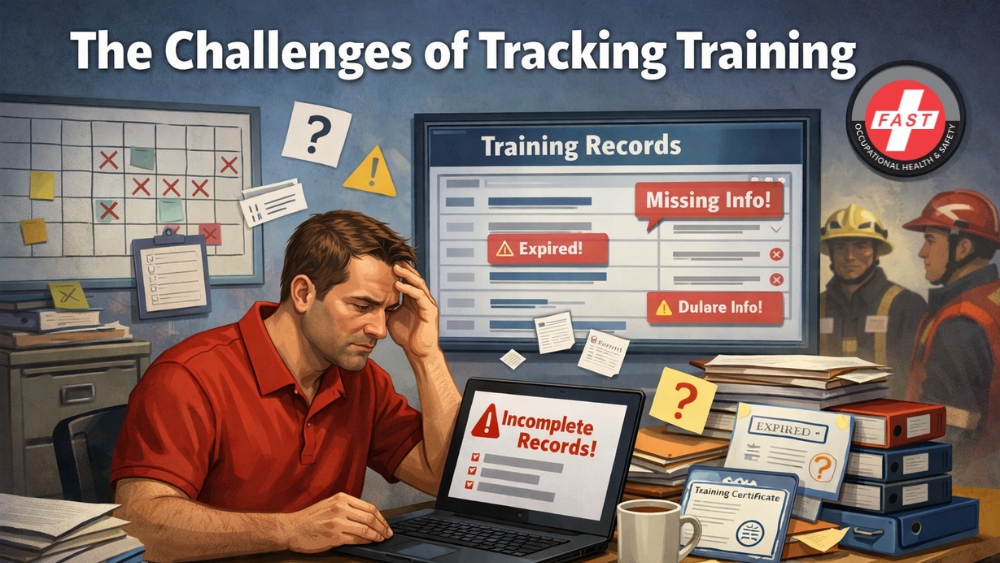
Training generally involves two parts: delivering the training itself, and tracking what has been completed.
This challenge is familiar to many Canadian organizations, where training requirements, renewal cycles, and documentation expectations must be maintained over time.
While organizations often focus on delivery — whether through onboarding, in-house programs, or external providers like First Aid — tracking tends to receive less attention until it becomes necessary. Knowing who has completed what, where records are stored, and whether training is still current becomes harder to maintain consistently over time. These challenges don’t usually appear all at once. They surface gradually as organizations grow, roles change, or training comes from multiple sources — making it harder to see, at a glance, where things stand.
Tracking Training Over Time
In practice, tracking training is largely about maintaining visibility.
In many organizations, training has been completed, but there is no clear shared view of it. Records exist in different forms and locations, making it difficult to quickly see who has completed which training, what is current, and what may have expired.
Over time, this becomes harder to manage. People change roles, move between locations, or complete different types of training. Certificates may be stored in multiple places, status may be tracked inconsistently, and information that was once easy to find requires more effort to piece together.
The challenge is not whether training has happened. It’s whether training status can be easily seen and understood without manual checks, follow-ups, or reconstruction. Tracking training, in this sense, is less about recording individual events and more about maintaining ongoing visibility.
Why Tracking Becomes Harder to Maintain
Tracking training isn’t a one-time task. It’s affected by time, change, and movement.
Many types of training are completed on a recurring basis rather than all at once. Some training is renewed on a set cycle, while other requirements are triggered by role changes, onboarding, or operational needs. As a result, training is completed at different points in time — sometimes in groups, sometimes individually.
This means training status is rarely static. At any given moment, some training is current, some is nearing renewal, and some applies only to specific people or situations. Over time, keeping track of this becomes harder, especially when:
- requirements don’t apply equally to everyone
- training needs to be refreshed or repeated
- records are updated at different times or stored in different places
- reporting needs don’t align neatly with how training was assigned
The result isn’t failure — it’s uncertainty. Organizations spend more time confirming what has already been done than clearly seeing what applies now or what needs attention next.
What Organizations Are Really Trying to Do
Ultimately, organizations aren’t trying to track training for its own sake. They’re trying to maintain a clear, reliable understanding of where they stand.
That means being able to answer practical questions without starting from scratch each time:
- What training is required?
- Who has completed it?
- What is current, and what needs attention?
- Where are certificates or other training records if they’re needed?
How organizations choose to manage this varies. Some rely on spreadsheets or shared folders. Others use internal systems or external tools. What matters is not the method, but whether it provides a clear, consistent view when questions arise.
The Organizational Benefit: Clarity and Continuity
When training records are clear and accessible, conversations change. Reviews are more straightforward. Questions can be answered without retracing steps. Decisions are based on what is visible, rather than assumptions or reconstruction.
This doesn’t reduce the importance of training or compliance. It helps organizations see the effort they are already making and understand how it holds together over time. Expectations are easier to explain, responsibilities are clearer, and follow-up becomes more focused. In practice, this kind of clarity reduces rework and uncertainty. Instead of repeatedly confirming what has already been done, organizations can spend more time managing what needs attention next.
How a Training and Compliance System Can Support This
A Training and Compliance System is designed to support how organizations manage training information more consistently. It doesn’t replace judgment, decision-making, or existing processes. Instead, it provides a structured way to bring training records together so they can be viewed and maintained reliably.
Rather than reconstructing history each time a question arises, organizations can use a system to:
- see training completion and status in a single, shared view
- track certificates and renewal dates over time
- maintain records as people move between roles or locations
- understand what applies now, without relying on manual checks or follow-up
Used this way, a Training and Compliance System helps organizations maintain continuity as training requirements, records, and people change. It supports clarity and consistency, without requiring training to be managed perfectly or all in the same way.
Ready to Get Started?
Gain a clearer, more reliable view of your training and compliance. Connect with F.A.S.T. Rescue to learn how a Training and Compliance System can support training tracking, certificate visibility, and ongoing consistency over time.